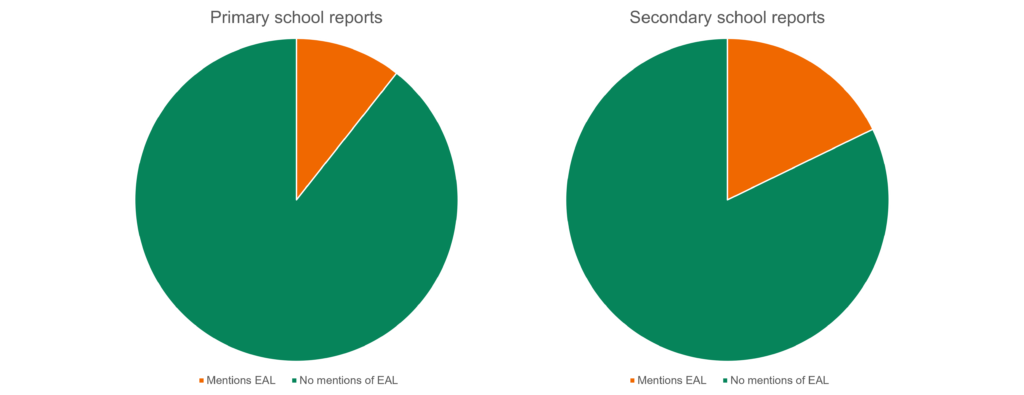
In response to the “Every Child Achieving and Thriving” white paper, as part of The Bell Foundation's submission to the Select Education Committee, we analysed a sample of Ofsted inspection reports (47 primary and 118 secondary) published since the launch of the new inspection framework in October 2025 through to May 2026.
This represents around half of state-funded secondary school reports published during the period, and a limited sample of primary school reports.
While the new Ofsted 2025 inspection framework for schools signals that EAL learners are beginning to feature more prominently in accountability measures, a closer look at the latest Ofsted reports tells a different story.
Our analysis suggests that the experiences and outcomes of EAL learners are not always explicitly visible within inspection reporting, even for schools where we would expect this to be a key component of their provision.
What did our analysis suggest?
The evidence reviewed suggests that:
- Only one in six Ofsted inspection reports mention EAL learners.
- There are very few references of EAL provision, even in schools with a higher proportion of EAL learners.
- Where a school’s EAL provision is referenced, it is largely positive, but often not in enough detail to ascertain useful information. For example, many of the reports use broad phrases that are ambiguous in whether they include EAL learners, such as “students who experience barriers to learning”.
Chart 1: EAL is mostly mentioned under "inclusion" but is much less visible in other areas
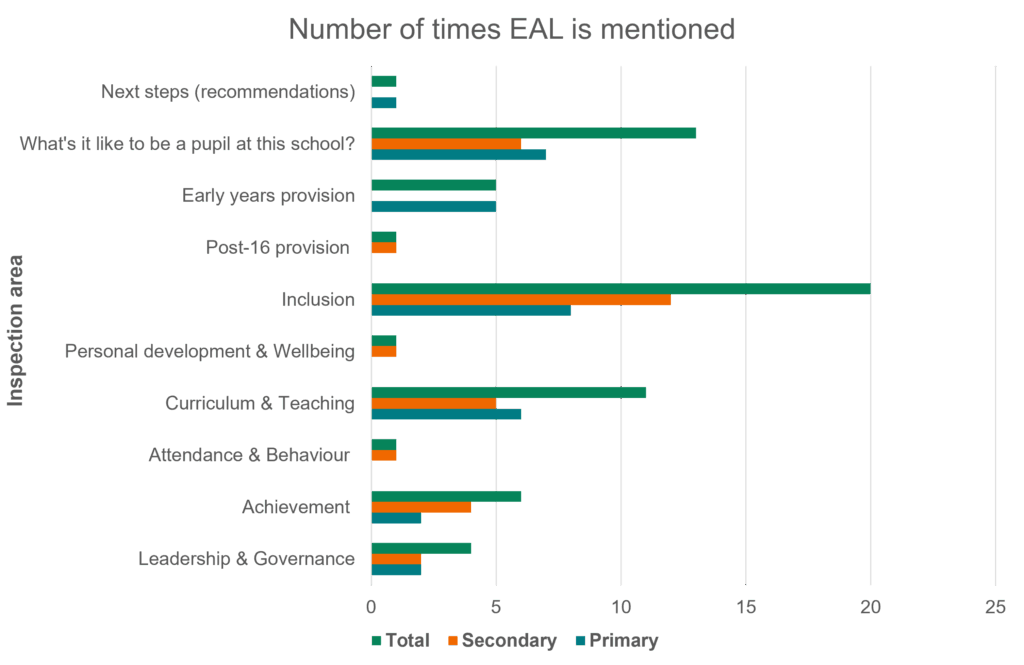
Chart 2: EAL is mentioned in only 13% of primary and 15% of secondary reports analysed