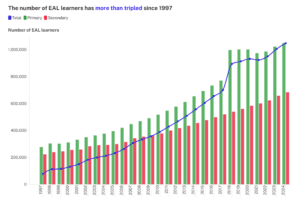



Key findings:
- Two thirds of schools in England now have at least 5% of EAL pupils on the school roll, meaning that more schools face the challenge of recognising need and understanding how to provide tailored support.
- The later an EAL learner joins school, the harder it is for them to catch up in education. Unlike monolingual English-speakers, EAL learners who join school at any time after Year 5 have lower attainment on average by the end of Year 11.
- At primary school, EAL pupils joining any time after Reception score substantially below the national average for Key Stage 2 Reading since they have had less time to develop their English language proficiency.
- Similarly, EAL learners that start secondary school any time after Year 7 struggle to achieve the national average, even after several years in the country.
- EAL learners with a SEN are being disproportionately left behind at secondary school – performing significantly worse in Reading and Maths than monolingual pupils with a SEN.
Recommendations for policy:
In response to this evidence, The Bell Foundation is urging action from the Government to:
- Reintroduce statutory assessment of English proficiency in schools, since it can inform tailored support for those pupils who are being left behind.
- Generate EAL expertise in schools through effective teacher training: EAL guidance around understanding English proficiency is absent from the recently updated teacher training frameworks and should be included.
- Maintain EAL resources in the National Funding Formula (NFF): The three years of funding offered to EAL pupils from the NFF to support their learning of English is not enough to close an EAL attainment gap for some learners. As our previous research has shown, EAL funding needs to be better targeted to enable up to six years of funding for those that need it to achieve academic proficiency in English.