Preparing for Ofsted: Inspection of EAL Provision
Discover practical resources, expert insights, and training to help educators prepare for inspection of EAL provision under Ofsted’s updated inspection toolkit for state-funded schools.
As of October 2025, Ofsted’s updated inspection toolkit for state-funded schools (page 20) now includes a dedicated section on English as an additional language (EAL) within the Curriculum and Teaching evaluation area.
This means that Ofsted inspectors are now explicitly asked to consider how schools support pupils at the early stages of learning English. This is a direct result of The Bell Foundation’s continued efforts to encourage Ofsted to assess the targeted support, accountability, and leadership that is in place to enable EAL pupils to thrive at school.
This update gives schools a real opportunity to reflect on what’s working well and to strengthen their EAL provision through a whole-school approach.
Katherine Solomon
Director of Programmes and Partnerships
Resources for school leaders
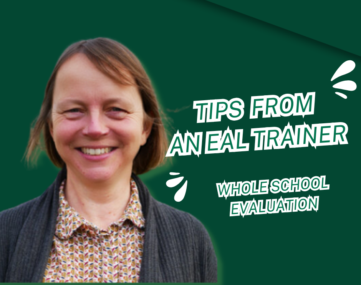
In this video, Caroline Bruce introduces our free EAL Whole School Self-Evaluation Toolkit.

This webinar explores practical ideas for how schools can evaluate and develop their provision for multilingual learners, considering the importance of evaluating your whole-school EAL provision and introducing a new framework to ensure the evaluation is thorough and meaningful.
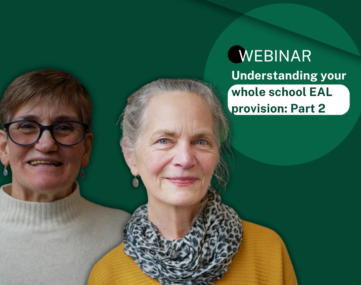
In this webinar, we look more closely at activities that will help inform your understanding of your school’s EAL provision, and will in turn shape future development.

We offer EAL accreditation for the UK schools. Our accreditations are carried out online, offering an affordable, robust and worthwhile proposition for schools to demonstrate the quality of their EAL provision.

Explore five principles that are intended to guide schools as they develop and embed effective provision for learners using EAL.

The Bell Foundation's award-winning EAL Assessment Framework for Schools and digital EAL Assessment Tracker are available free of charge to all schools in the UK.
Resources for EAL co-ordinators, teachers and teaching assistants
Explore five principles that are intended to guide schools as they develop and embed effective provision for learners using EAL.
The Bell Foundation's award-winning EAL Assessment Framework for Schools and digital EAL Assessment Tracker are available free of charge to all schools in the UK.

The Bell Foundation's Whole-School Self-Evaluation Toolkit provides forms and accompanying guidance to enable schools to conduct a comprehensive self-evaluation of their EAL provision, including planning for next steps in developing the provision.
In this video, Caroline Bruce, Training Manager at The Bell Foundation, introduces our free EAL Whole School Self-Evaluation Toolkit.

This guide aims to support educators in creating learner profiles that will lead to improved learning environments, well-being and academic success for plurilingual learners.
For school leaders

For EAL co-ordinators, teachers, and teaching assistants
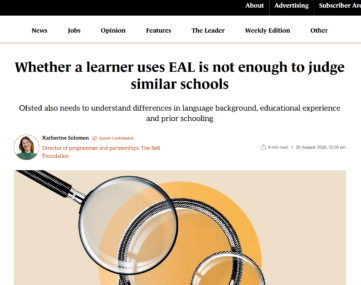
In her latest article for Schools Week, Director of Programmes and Partnerships Katherine Solomon discusses the inclusion of EAL in Ofsted’s “similar schools”. She explains why understanding a child’s English proficiency can provide valuable context and help schools identify how best to support EAL learners to access the curriculum and achieve their potential.

Following her session at our conference, Laura Tarantini-Amor, one of our Licensed Practitioners, explores how the Harris Federation has focussed on overcoming the barriers faced by EAL learners as they respond to the needs of the updated Ofsted Inspection Toolkit.

EAL is now back in the Ofsted toolkit, which has implications for schools at their next inspection. We sat down with Mark Sims, former His Majesty’s Inspector, to find out what this means in practice and how schools can best showcase their tailored provision for schoolchildren who don’t speak English as their first language.

In this opinion piece for TES*, Katherine Solomon, Head of Training and Resources reflects on what the recent inclusion of EAL in the new schools inspection toolkit means for schools

With more than 1 in 5 learners in England’s schools speaking English as an additional language, ensuring inclusive practice is vital – especially in light of Ofsted’s new inspection framework. Our EAL trainer, Sarah Moodie, outlines four steps for reviewing your school's EAL provision.

In this opinion piece for Schools Week*, our Strategic Education Advisor Silvana Richardson explains how Ofsted's new framework can begin to account for the diverse needs of students for whom English is an additional language.

Setting accurate language targets and using tailored strategies will be crucial if schools are to meet the new Ofsted inspection requirements around provision for students who use English as an Additional Language. Caroline Bruce and Silvana Richardson explain and advise.