 “Why do you have to speak like this?”
It was my very first day in my very first teaching job, a Reception class in an infant school in Essex. I had joined a child at the Play-Doh table, hoping to ease him gently into his new school environment. He looked up at me, curious and completely unfiltered.
“Why do you speak like this?” It was the question that would stay with me for the rest of my career.
“How do I speak?” I asked.
“Can you not speak English?”
“But I do,” I said. “I am speaking English to you right now, and you understand me, don’t you?”
“Yes,” he said, “but you speak so funny.”
I explained that it was my accent: that I came from a different country, spoke a different language, and had worked hard to learn English so that I could become a teacher. He listened with attention. When I finished, he shook his head slowly, let out a sigh, and delivered his verdict: “Where do you people even come from?”
It was, I later realised, the perfect introduction to a topic I would go on to teach every year: Where do the people in our community come from? A unit that linked beautifully with all EYFS outcomes and, as it turned out, with my own story.
Nearly There Yet
A few years later, I had moved to Bedfordshire. It was the summer term, and I was taking my Year 1 class on a school trip. Every teacher knows the energy in a coach full of excited six-year-olds. We had barely left the school gates before the chorus began:
“Are we nearly there yet?”
After perhaps the fifth time, my answer remained patient and unchanged: “Not too long now.”
Behind me, I heard a small voice whisper to a neighbour: “I think she’s taking us to Poland.”
I smiled to myself.
In that one offhand comment was an entire world of questions worth exploring: How far away is another country? What does it mean when your teacher or peer comes from somewhere else? And what assumptions do we carry, even at the age of six, about people who sound different from us?
What EAL Really Means
During my teacher training, I learned that new-to-English pupils may need to hear a new word or concept up to 21 times, and use it themselves in context up to 21 times, before they fully internalise its meaning. I think about that statistic often, because it reminds me that language acquisition is not a switch that flicks on. It is a process, built slowly through repetition, context, and confidence.
Each week, I deliver EAL assemblies where I talk openly about speaking different languages, share stories of how I learned English myself, and celebrate the cultures and countries our children come from. My goal is for every child in our school to understand not just what EAL stands for, but what it means, and to feel proud of it.
And yet, even now, in the spring term, when I ask my EYFS pupils what EAL means, many of them still tell me: “Does it mean we are all from Poland?”
It makes me laugh every time. It also reminds me how much work there is still to do.
The Children at the Centre
Within our EAL community, there is a smaller and particularly vulnerable group: refugee children. Although the percentage of refugee pupils at Maidenhall Primary School is relatively small, they are never far from our thoughts. Their needs extend far beyond language. We plan deliberately and carefully to improve their outcomes – not only academically, but emotionally, socially, and practically.
Our family workers walk alongside these families in ways that go well beyond the classroom. They work with charities to provide food vouchers, festival food parcels during Ramadan and Eid, shoe and uniform vouchers, hygiene packs, and translation support for official documents. They direct families to the right agencies, charities, and authorities to help navigate the complex systems that surround them.
In school, we provide additional EAL phonics sessions, language development interventions, and one-to-one pastoral support with trained staff, so that every child has the tools to read, write, communicate, and begin to feel at home.
But I often ask myself: Is it enough? In the fast-paced environment of a school day, do we give these children enough time? Enough intentional, trauma-informed attention?
Enough space to heal, recover, and adapt at their own pace?
Saving the Butterfly
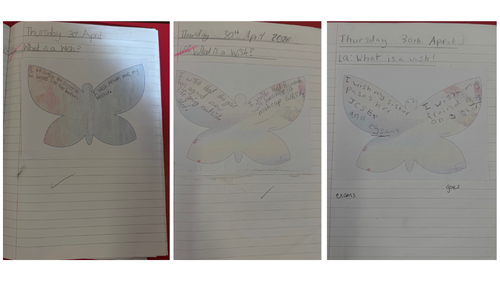
It was a picture book that brought these questions into sharp focus for me. Saving the Butterfly by Helen Cooper tells the story of two young siblings, the only survivors of a refugee boat crossing, who are brought to a new country and must begin again. The younger brother ventures outside, explores, and slowly starts to connect with the world. His sister stays indoors, trapped in the weight of what she has witnessed, hiding from the dark in her mind. When he brings her a butterfly, it becomes something extraordinary: a quiet, fragile symbol of hope, healing, and the patience that recovery demands.
The story moved me deeply. The illustrations do much of the emotional work: inky blacks for the sea, dull pastels for the camp, then sudden warmth as colour floods back in. It is a book that does not simplify grief or trauma, and yet it is entirely accessible to young children.
I knew immediately that it needed to be part of our curriculum. I added Saving the Butterfly to my Year 2 English planning. Not only as a literacy text, but as a gateway for children to recognise, talk about, and begin to understand the emotions that some of their peers may be quietly carrying. The story gives children the language and the permission to ask: What might someone who has been through this be feeling? How can we be kind to someone whose story we do not fully know?
For KS1, I also planned a whole-school assembly around The Colour of Home – the story of a Somali boy who has fled war and must find his place in a new classroom, a new country, a new life. Together, these two books open a door to the kind of empathy that cannot be taught through a worksheet. It has to be felt.
The Journey Continues
Language and identity are fragile, especially in young children. They need to be nurtured, modelled, and consistently celebrated. But so does compassion. We cannot assume that children will instinctively understand what it means to be a refugee, or the cost of leaving everything familiar behind to begin again in a new and unfamiliar place.
We have to teach it – gently, honestly, and through stories.
As educators, we can nurture an understanding that every child in our class, and the children sitting beside them, may be carrying something heavy, and that kindness, like a butterfly, can be both the smallest and most powerful thing in the world.