Julia Trickey, PGCE Primary with QTS Programme lead, University of Derby
With thanks to
Charlotte Moore, Teacher, EAL and Music Lead, Firs Primary School
Ann Brown, Teacher, PSHE and EAL lead, St Peters CE Junior School
Kim Muir Senior Lecturer in Education & TESOL, University of Derby
Having English as an Additional Language (EAL) is a superpower, but how can we use talk to help young pupils unlock this power to its full potential? Through high-quality talk, explicit vocabulary instruction, and purposeful opportunities to practise new language, children who use EAL develop the confidence and academic language they need to thrive across the curriculum. We share examples from our teacher training programmes and our partner primary schools across Derby.
What do trainee teachers need to learn about effective EAL pedagogy?
The Initial Teacher Training and Early Career Framework promotes the inclusion of oracy within the trainee teacher curriculum, to build understanding and proficiency in enabling effective classroom talk. Early career teacher surveys often highlight the dip in confidence when teaching learners who use EAL.
Here at the University of Derby, as a Centre of Expertise for The Bell Foundation, we champion the contributions our multilingual classrooms can bring to our trainee teachers, embedding opportunities to experience adaptive EAL pedagogy in an authentic classroom context. The five principles to guide effective EAL pedagogy – as outlined by The Bell Foundation – are embedded within our ITE curriculum. 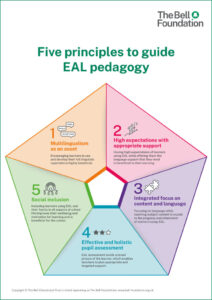
It is critical that trainee teachers have authentic experience and training focus on multilingualism as part of their training provision. As an outstanding provider, we provide an Intensive Training and Practice week with a focus on multilingualism, where our trainee teachers observe, analyse, prepare, enact, and reflect on EAL specific pedagogy in our language-rich partner schools. They explore how to value multilingualism as an asset in settings where expectations are high for all learners through the inclusion of community events and drawing on dual language texts and home languages in classroom tasks. By observing expert mentors in schools, they explore how to enrich the curriculum, working to empower all learners to build language proficiency.
Our trainee teachers also explore the importance of effective communication through a focused Communication and Language learning day, looking at the importance of social inclusive and accessible talk to build connections with friends. Although for some, their time in our partnership schools is an eye-opener to the rich diversity into our classroom spaces, trainees state that they felt ‘more confident in teaching pupils using EAL’ after their experiences.
Is your delivery comprehensible for all learners or are there barriers for those new to English?
The narrative around EAL pupils often focuses on barriers they may face to accessing learning. However, perhaps we should also consider whether it is us as practitioners who might be preventing children from unlocking their “superpowers”?
Comprehensible language within the classroom means there is an inclusive environment for all ages and abilities. As practitioners we should be mindful of not only what we say but the way we say it. The speed of our speech can significantly impact our child’s understanding. In addition to this, hesitation and utterance can make it difficult for children who use EAL to identify the key message that is being delivered.
We should also consider our use of colloquialism and idioms. Phrases such as ‘break a leg’ and ‘it’s a piece of cake’ may be misunderstood by those who interpret language literally. Similarly, complex sentence structures containing multiple clauses can increase the cognitive load placed on children who are still developing proficiency in English.
At St Peters CE Junior School in Derby, our staff have been making learning more comprehensible through visual supports, pre-taught Tier 2 vocabulary, sentence stems and structured scaffolds. Key vocabulary is displayed and revisited regularly, while word banks, personalised dictionaries, writing frames, and modelled examples support independent learning. During reading and comprehension activities, pupils rehearse responses orally before writing using the “I do, We do, You do” approach. Feedback from the children shows that these strategies have increased their confidence, reduced anxiety and supported more effective communication, with one pupil commenting: “Having my own word book (dictionary), where the teacher records tricky words, helps reduce my worries when writing.”
Top tips for using oracy with EAL learners
- Build topic vocabulary – categorise key vocabulary across the curriculum focusing on tier 2 words
- Identify vocabulary gaps – implement assessment strategies to guide teachers and close the vocabulary gap (www.bell-foundation.org)
- Embed immerse opportunities – plan authentic and adaptive activities that reduce cognitive load by building on what they already know and what is already familiar
- Empower engagement – scaffold speaking before writing, welcoming first language into the classroom
- Repeat, repeat, repeat! – use and retrieve target words in multiple contexts
- Be bold – use Exit tickets to celebrate daily progress
- Engage in action research – explore how you can close the vocabulary gaps within your own classroom setting to unlock every child’s potential across the curriculum
Focus on vocabulary to strengthen learning
At Firs Primary School in Derby, our children speak 52 different languages.
Each year, children are assessed three times using The Bell Foundation Assessment Framework to determine their English language development and support needs across speaking, listening, reading and writing. Assessments and ongoing monitoring showed many children had strong social language skills; however, vocabulary gaps became more evident within their academic language proficiency.
Following a review of explicit vocabulary teaching at Firs, we identified the need to place greater emphasis on Tier 2 cross-curricular vocabulary to close the gap more quickly, as these words are closely linked to academic success. Using Beck et al.’s vocabulary research, we explored three tiers of vocabulary Tier 1 (basic everyday words, e.g. fruit), Tier 2 (academic vocabulary, e.g. evaluate), and Tier 3 (subject-specific terminology, e.g. ingredient). This framework enabled teachers to identify high-value curriculum words, ensuring children were immersed in a language-rich environment supporting language development and academic achievement.
We carried out an action research project selecting a sequence of lessons and identifying six Tier 2 vocabulary words. Following a consistent routine based on the EEF’s Vocab in Action approach, we pre-taught each word with a definition, example and non-example. Stem sentences were used to rehearse vocabulary, followed by retrieval activities so children could reuse the words in talk and writing. The sequence ended with an exit ticket to check understanding through misconception checks, application, recall questions, and assessment.
As a Voice 21 school, our staff found that building time into lessons to explicitly discuss Tier 2 vocabulary supported children’s understanding of word meaning. Through morphology and etymology, pupils developed a deeper understanding of word origins and structure. We used strategies such as Word Aware and non-examples to support vocabulary development. New vocabulary was revisited through quizzes, challenges and retrieval activities in morning routines, helping children retain and use language confidently.
Our action research showed that combining explicit vocabulary instruction with oracy opportunities improved children’s use of academic language. We noticed pupils becoming more confident using Tier 2 vocabulary in discussions and writing. Regular rehearsal, revisiting and application helped children remember and use ambitious language more independently, strengthening communication and supporting access to the wider curriculum.
Since then, teachers across the school have adopted this approach in planning, carefully selecting Tier 2 vocabulary and embedding opportunities to revisit and retrieve words through discussion, challenges and short retrieval activities.
Summary
In conclusion, these examples from our partner schools show that using assessment, planning, and classroom practice to remove barriers has helped pupils access the curriculum more successfully. Combining oracy with explicit, consistent vocabulary teaching enables multilingual learners to unlock their full potential. By reducing cognitive load without lowering challenge, schools can create a low-threshold, high-ceiling approach that supports all children to participate, achieve, and succeed.
The views and ideas presented in this blog are the author's own and do not necessarily represent the views of the Foundation.