Christian: So, what are some of the challenges that our ESOL learners face?
 Clare: Our ESOL learners come to us with a range of challenges in that they've got so much going on outside of their studies. Those who are doing their asylum claims are in a constant state of flux – they don't know whether they're staying or going. Trying to balance that with studying can be tricky.
Many of our learners have experienced various hardships in their journey to get to the UK, which can understandably cause mental health issues. We try to provide a safe space, as many learners can feel lonely and isolated when they first come to us: having a dedicated member of staff within our ESOL department has been absolutely key to gaining the trust of our learners and supporting them when they need a friendly face. Christian, how would you say our ESOL programme has been adapted to meet our learners’ needs?
Christian: Many of our adult learners have low paid shift work, meaning that they can't commit to an evening class every week. So, we have put together lots of different ways to access our education. Our digital offering enables our learners to study online at home. Alongside that, we offer in-person lessons for those who want to have that increased sense of community and build friendships with others.
Clare: Yes, the flexibility of our courses has worked well. We also partner with local businesses who have employees who are new to English, some of whom might be working in jobs that they are overqualified for. Our programme involves supporting employees who would benefit from ESOL classes: learners are typically granted an hour within their workday to study with us and then another hour of private study in their own time. Not only does this incentivise learners to learn, but it also means that the employer has a workforce that can communicate better and thrive – it’s a win-win for everyone.
Christian: Why do you think our programme has been recognised?
Clare: I think it comes down to the fact that we offer our ESOL in so many ways – it's really inclusive. No matter your personal situation, there is always a way to learn with us.
We’ve also built strong relationships with external organisations and charities who work in the local community. For example, we recently partnered with local charity Gladca to host an intergenerational cooking event. Residents who might not normally choose to enrol at college were invited to come and cook with our younger learners at the college, giving them the opportunity to make new connections within the local community. What are the main outcomes that we have seen in our ESOL students here at the college?
Christian: It is great to see learners’ increased confidence as they develop their language skills, gain trust with others at college, and progress on to different things, whether that be further study or simply having the confidence to give a presentation to a group. Many start to build a picture where they have a vision for the future which they maybe didn’t have before.
We've had lots of students that have gone on to gain jobs in healthcare, hospitality, and construction, which are inspiring examples of progression from entry level to Level 2 ESOL classes, all the way through to our mainstream vocational provision and eventually the workplace.
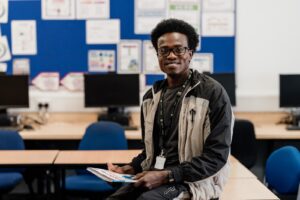 Clare: Yes, student destinations are really varied – some have gone to university, and some have even trained to become doctors, while others have become qualified barbers after studying Barbering with us.
We also have lovely success stories of learners who have progressed to work with us here at the college. One of our construction technicians started with us as an ESOL learner and is now supporting other learners, and another of our former learners now works with our own Management Information System.
Christian: Do you have any personal highlights, Clare?
Clare: We had an adult ESOL learner who was named the college’s Student of the Year. His journey to college was remarkable: he'd previously been a refugee from Afghanistan who had moved to Ukraine, where he then became a refugee for a second time. It was inspiring to see the amount of work that he did with other students to empower them to be the best version of themselves. What are your highlights, Christian?
Christian: I've been at the college for over 10 years now, so what I really enjoy is walking around the campus and catching up with many of our former ESOL students. It’s nice to hear about what they are studying now and the progress they have made. So, what's next on the agenda for our ESOL programme?
Clare: One thing we’re looking at is incorporating WorldSkills into our ESOL offering – a programme that raises the prestige of skilled trades and vocations and provides a pathway to professional success. We’d also like to consider how we can get more out of our student feedback surveys. It's imperative to ensure that the needs of our learners are understood, and so we’re looking at using translation tools for our surveys to ensure that we get a truer picture from our learners on what we are doing well and how we can improve.
*Clare Wookey is Assistant Principal for Adults and Partnerships, and Christian Adams is Head of Faculty for Adult Skills, ESOL and Digital Learning at Peterborough College.