Why family engagement matters in multilingual schools
Multilingualism is the mainstream reality in the vast majority of English medium international schools. Many learners move between multiple languages, cultures, and identities each day and this diversity creates huge opportunities for learning. Schools must carefully consider how languages, identity, and family engagement interact to ensure that multilingualism can be harnessed as an asset.
Research shows that multilingual environments support cognitive development, encouraging flexible thinking and problem solving. This means building trust and partnership with families is important because it sits at the heart of multilingual learning. It is central to fostering learners’ belonging, language development, and academic confidence. By building meaningful relationships with families, schools gain access to cultural knowledge, linguistic resources, and lived experiences that enrich the learning environment for everyone.

Home languages as a resource and the 'multilingual habitus'
Home languages are a resource because they link to the development of cognition and literacy: being able to consider and discuss or write about ideas in your strongest language strengthens cognitive development. Understanding key concepts and ideas in home languages supports the growth and development of academic language which learners need to engage deeply with subjects across the curriculum.
This home language knowledge can act as a bridge to academic language development in additional languages and can accelerate and strengthen, not hinder, English language development. For international schools, then, encouraging the growth of all languages, not just English, can provide numerous academic and social benefits for learners and families. But what does this look like?
One framework for elevating home languages involves creating a ‘multilingual habitus’ – a term devised by Eowyn Crisfield. This means making the home languages used by learners and staff visible and welcomed.
This includes having multilingual displays, libraries, and ‘world language days’, but – crucially – it’s about moving beyond occasional celebrations to embedding multilingual practices into school culture and normalising the presence and use of multiple languages within the school.
Partnership with multilingual families is key to achieving this. For example, recruiting ‘parent ambassadors’ from different language groups to create further communities of parents who share a language and giving them a voice and agency within the school.
Inviting parents into the school to read and share their language with younger learners is a simple way to increase the visibility of other languages. When learners feel their language and identity are valued, participation increases, learners take greater risks, and progress accelerates. A sense of belonging is not just connected to well-being but corresponds to academic success.
From outreach to partnership
An important insight from building strong partnerships with families is that it requires a shift in mindset: from ‘communicating to families’ to ‘learning with families’. Gemma Donovan outlines four things school leaders can put in place to create a school environment where partnerships with multilingual families can thrive:
- Clear messaging: Share research and information on how home languages strengthen learning.
- Staff confidence: Ensure there is a shared-understanding of language-aware practice through whole-school CPD, targeting leaders, teachers, and teaching assistants.
- Protected structures: Create time and routines for engagement in CPD and opportunities for involving families. Ensure language-friendly practices are being considered in school development activities such as learning walks or observations.
- Linguistic dignity: Build a culture where languages and language varieties are valued, respected, and accepted, not through tokenism, but by normalising the visibility and presence of multilingualism within the school.
Gemma acknowledges that it isn’t always easy to embed these changes. There will be challenges, such as families arriving with strongly held ‘English-only’ beliefs and staff who may feel uncomfortable with learners using unfamiliar languages in class.
At ISP the aim is to provide targeted responses to these concerns. For example, parental desire for an ‘English-only’ environment is rooted in aspiration which can be addressed by re-framing the narrative so that parents and learners see the value of using all of a learner’s languages to achieve academic success and building a shared understanding of what successful learning looks like in multilingual classrooms. To address gaps in home-school communication, it is important to systematise engagement. Gemma gives the example of a policy within ISP that no communication should be above a B2 (upper-intermediate) level of English, and that, where possible, translations are provided when communicating with parents.
Case study: The Home Language Project
Ben Sell is MFL teacher and Multilingualism Lead at Park House International School in Qatar. He started a project to address the challenge of home language development within a school where over 30 different home languages are used. Ben introduced a weekly home language hour with his Key Stage 2 students (ages 7-11).
To get around the impossibility of teaching 30 different language programmes, in each lesson the learners set their own targets and worked independently to achieve their chosen outcomes, facilitated by a teacher. For example, one child might choose to listen to traditional Korean music and compare it to modern K-pop; this entails the child engaging with a range of music in their home language and learning the names of traditional (and modern) instruments in Korean, then writing a summary of their findings in English (see image below).
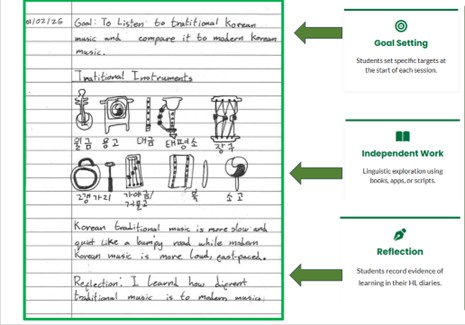
Image: Ben Sell
For younger children the goal setting is more scaffolded, with choices offered to the learners as they develop the ability to self-reflect on their own language-oriented learning goals.
For those children whose first language was English, they explored international, regional, or historical varieties of the language, or studied the literature, folktales, or history of other cultures through English.
In order to promote reflection and continuity, each child had to keep a ‘home language diary’ detailing their learning goals and outcomes. Children were free to use the diary in their own way, with some treating it like a vocabulary book, whilst others used it in a less structured way. The home language diary provided pedagogical value by serving as a translanguaging ‘safe space’ that also facilitated the development of academic language allowing learners to analyse and compare their home language with English. It also served as a record of home language literacy and progress and, importantly, acted as an accountability tool because learners knew that they would have to show what they had done to a teacher or parent.
The final impact of the diary was to strengthen home-school communication and, in particular, to strengthen links between children and parents by facilitating engagement in the home language. This led to some parents acting as teachers or guides of the home language through highlighting mistakes and adding corrections (see example in Telugu, below).

Image: Ben Sell
Some parents even became co-learners with the child as they rediscovered their home language, as illustrated by this quote:
“It’s so strange…I haven’t had to write it in years, and I was really surprised by how much I had lost…lost that skill” – Year 6 parent.
Despite Ben’s fears that parents might feel opposition to the project, due to children not being taught by language specialists, or a sense the lessons might be encroaching on family life, parental feedback has been overwhelmingly positive. Elevating the status of home language to an academic subject through these short, weekly home language ‘lessons’ provided structure, allowing learners to engage better with their home language and allowing discussion about home language to organically permeate home life.
Ben is currently collecting data on the impact of this project as part of action research and is seeking to expand the programme to other stages of the school.
Alignment is the key
This project demonstrates that by viewing multilingualism as an asset to exploit, rather than a problem to manage, schools can work with their multilingual families to achieve powerful outcomes. By aligning leadership, classroom practice, school culture, and family engagement, schools can create a valuable sense of belonging and achievement for their multilingual pupils.