
What is CLIL and why is it useful?
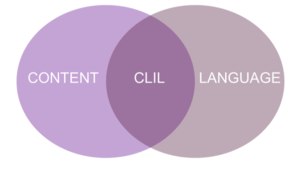
CLIL stands for Content and Language Integrated Learning. The approach emerged as a fusion of content learning and language learning – two areas that had previously been seen as distinct.
CLIL is not a methodology but an approach to structuring, planning, and teaching a curriculum. It is characterised by:
- Having a dual and equal focus on language and content.
- Being taught via a learner’s second or additional language.
- Being based on a social, collaborative model of learning.
- Employing language supportive teaching methods to develop content and language knowledge at the same time.
These characteristics make CLIL a useful model for many multilingual international schools, especially those that use inquiry-based or project-based approaches to learning. The appeal of being able to combine language development and curricular learning and do them simultaneously - to ‘buy one and get one free’ - is obvious.
However, CLIL is not necessarily a panacea or a quick fix. Unless it is implemented with appropriate support and training for staff and pupils, it can be counterproductive. This article looks at some of the key concepts within the CLIL approach and explores how we can apply these effectively in a multilingual school context where English is the main language of teaching.
The key concepts of CLIL
The 4 Cs
This is one of the most popular CLIL frameworks and is a memorable way to describe the core characteristics of a successful CLIL lesson: content, communication, cognition, and culture, as detailed in the table below.
|
The 4 Cs (Coyle, Hood & Marsh, 2010) |
|
|
A CLIL lesson should include: |
|
| 1. Content | Progression in knowledge, skills and understanding related to the topic being studied – which means identifying and teaching the vocabulary and grammar needed to access curriculum content. |
| 2. Communication | Using language to learn, whilst learning to use language – in other words, identifying and teaching the language required to participate successfully in classroom activities and interactions. |
| 3. Cognition | Developing thinking skills, understanding, and language – this involves identifying and teaching the language required to express thoughts and ideas. |
| 4. Culture | Exposure to alternative perspectives, experiences, and shared understandings – which means moving beyond ‘food, flags, and festivals’ to teaching deeper knowledge about different cultures represented in the school and exploring the complex ways cultures, identities, and languages interact. |
This model provides a useful evaluation framework for understanding how well existing teaching and learning allows plurilingual learners to successfully access the curriculum. Many international schools will already be incorporating lots of these features into their teaching and learning, but identifying which areas are being consistently included in lessons and where there may be room for development will help strengthen EAL provision.
Principles for language integration
Ball et al. (2015) describe seven principles for ensuring effective language integration:
- Building bridges: recognising the need for teachers to ‘build bridges’ between the learner and the new subject knowledge they want them to acquire.
- Developing subject language awareness: this means learning what language is important in your subject area and how it is used.
- Planning with language in mind: ensuring language development is considered in lesson plans and schemes of work.
- Conducting a curriculum and language audit: identifying the crucial language knowledge and skills required in each area of the curriculum and ensuring these are present in the curriculum.
- Teaching general academic language: focusing on words, phrases, and structures that are useful across the curriculum and not only on topic-specific vocabulary items.
- Providing initial talk time: giving learners the opportunity to verbally process their ideas and activate the language and knowledge needed for the upcoming task.
- Sequencing activities from private to public: allowing learners the chance to practise and rehearse their ideas in a low-stakes situations before sharing them more widely.
Viewing language development as an integral part of helping learners bridge the gap between their existing understanding and new knowledge is an important mindset to develop for teachers in multilingual schools.
The language triptych
This model focuses specifically on how to ensure linguistic progression within the curriculum by identifying three areas of language that must be addressed, as illustrated below.
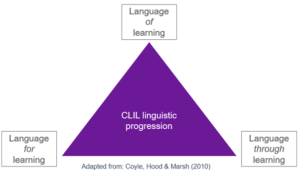
For international schools, ensuring that each area of the language triptych is addressed for all plurilingual learners will facilitate language development. This model is also a useful structure for identifying staff training needs focused on language development.
CLIL and collaboration
A CLIL approach demands that subject specialists or classroom teachers work closely together with EAL specialists when planning. Collaboration can be formally planned and coordinated by school leaders, or it can occur more informally. A joined-up approach might include:
- Arranging planning meetings between EAL staff and heads of department.
- Building in collaborative planning time between subject and EAL teachers.
- Employing co-teaching models.
A more organic approach might look like:
- Ensuring EAL teachers and classroom teachers share the same spaces for planning.
- Ensuring the EAL department has an ‘open door’ policy and welcome requests for support.
- Making sure EAL staff are valued and used effectively.
A final thought
None of the individual strategies or techniques we’ve mentioned as part of a CLIL approach are new or specific to CLIL; its usefulness lies in the planned and purposeful combination of language, content, and culture across the curriculum. It is this which makes CLIL a useful framework to support international schools interested in embedding an intentional and integrated approach to language development.
References:
Ball P., Kelly, K., & Clegg J. (2015). Putting CLIL into Practice. Oxford: Oxford University Press
Chinn, R. and Norrington-Davies, D., 2022. Working with emergent language. Pavilion
Coyle, D., Hood, P. and Marsh, D., 2010. Content and language integrated learning (Vol. 221). Cambridge: Cambridge university press.