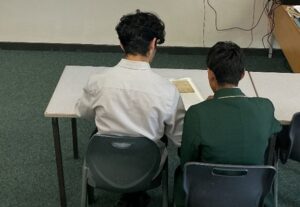
Alexandra: This year, we launched a paired reading intervention with the support of EMAS, Coventry City Council that brought together Sixth Form volunteers and younger multilingual students. The impact has been both academic and emotional; students’ self-confidence has increased as the programme has progressed.
Why paired reading for EAL learners?
For many multilingual learners using EAL, particularly those at level B or lower C English proficiency, reading can feel like a barrier rather than a bridge. Fluency, confidence, and comprehension all develop at different speeds, and students often need a safe, low-pressure environment to practise the new language.
I wanted to create a space where reading felt social rather than isolating, learners could take risks without fear, language was supported through relationships, not just instruction, and students could choose books that genuinely interested them.
Recruiting Sixth Form leaders
Recruitment was a really important part of setting the programme up for success. We worked with EMAS Coventry City Council to introduce the opportunity through promotional materials and application forms sent to tutor groups, and invited students to complete a short application form that was developed by the EMAS team. As part of the application, the sixth formers had to explain why they wanted to get involved and what they felt they could bring to the role. Many spoke about wanting to “make an impact” or support younger multilingual learners who were still developing their confidence in English.
The response was extremely positive, with 10 sixth form students applying and showing genuine commitment to developing their understanding of the programme and their role within it.
We focused on selecting students who demonstrated qualities that make a real difference in paired reading, including:
- patience
- enthusiasm
- reliability
- confidence
Once the sixth formers were chosen, they attended a training session delivered by EMAS Coventry City Council. This gave them practical strategies for supporting EAL learners and helped them feel prepared for their mentoring role.

Marilena Richards, Advisory teacher for EMAS Coventry City Council, collaborated with the school to support with the implementation of the school’s paired reading Intervention.
In February 2026, I delivered training to all ten sixth formers, focusing on the purpose and principles of paired reading, equipping students with practical strategies to nurture reading development while building positive relationships with multilingual learners using EAL. During the training, we talked about their role as partner readers and how they could:
- Model fluent reading;
- Encourage and praise;
- Help decode tricky words;
- Ask questions to check understanding;
- Make reading fun, positive, and safe.
It was important to emphasise that praise was a key element to this intervention as the intention was to increase reading enjoyment alongside fluency and comprehension. Moreover, we explored the practical structure of paired reading sessions, including:
- Reading alongside a multilingual reader;
- Allowing thinking time before offering support;
- Supporting pupils when they become ‘stuck’;
- Correcting sensitively without over-correcting;
- Giving regular, constructive feedback.
During the training, it became clear that several of the sixth form volunteers had themselves been ‘new arrivals’ to the school just three or four years earlier, with some having previously been ‘new to English’ at the point of arrival. This brought an especially powerful dimension to the programme: students who had once navigated language acquisition themselves were now supporting others on a similar journey.
An important aspect of the training was helping sixth formers understand that reading with multilingual learners can sometimes differ from reading with monolingual peers. For example, a multilingual learner may understand a concept in their home language but not yet know the corresponding English vocabulary. Recognising this distinction helped students approach reading support with greater empathy and awareness.
To strengthen their practice, students were introduced to strategies for before, during, and after reading.
Before reading, students were encouraged to activate discussion and prediction through questions such as:
- “What is this?” (whilst pointing at an illustration)
- “What can you see on the cover?”
During reading, they practised:
- Matching the younger reader’s pace
- Encouraging pupils to track words with their finger
- Modelling pronunciation when needed
- Supporting without interrupting flow unnecessarily
After reading, students used simple comprehension and reflection prompts such as:
- “Describe the story in one sentence.”
- “Describe the main character using three words.”
- “What did you like about the story?”
Perhaps the most important reminder for the sixth formers was that their role was not to teach, test, or correct, but to encourage, model, and build confidence.
Practical considerations
- Structuring the intervention in a clear, predictable way helped the programme run smoothly and gave students a sense of routine. Sessions took place twice a week, Tuesdays and Thursdays for 15 minutes during form time. This regular schedule helped learners know what to expect and made the sessions feel manageable. EMAS supported us with confidence questionnaires and feedback forms to capture the less measurable but just as important growing confidence.
- Selecting the right younger learners was an important part of shaping the intervention. We focused on students who would benefit most from targeted fluency practice and the reassurance of a supportive reading partner. These included learners working at level B or lower C proficiency, newly arrived pupils, resettlement students, and those navigating both EAL and SEN needs. Learners often make the most progress when they’re supported by someone who can break down language, clarify new vocabulary, offer gentle explanations, and build their confidence one step at a time
- Choosing books carefully made a huge difference to engagement. After carrying out initial assessments, we matched each learner with texts that aligned to their reading age and book‑band level. To keep motivation, every student was given a small choice of books. They could pick from three options within their range one slightly easier, one right in the middle, and one offering a bit more challenge. We also made sure the selection included a mix of fiction and non‑fiction, plenty of visuals, and topics that reflected the learner’s interests. Giving students choice over what they read was essential.
- Pairing students thoughtfully was essential to making the programme work. We didn’t match students at random. We looked carefully at what each learner needed and what each Sixth Former could offer. Shared home language was a big advantage, as it supported communication and quick translation when needed. We also considered personality, making sure that learners who needed extra reassurance were paired with mentors who were patient and calm.
Student Voice: What it feels like to be part of the programme
Marilena: To better understand the impact of such a programme, I asked both sixth formers and the younger pupils to provide feedback. The sixth form students were given student confidence questionnaires to complete at the beginning and the end of the programme, while younger students were offered a feedback questionnaire which was translated into their home languages to ensure understanding. I was amazed by the positive feedback from all students involved and most importantly the positive connections it has created between the two groups of students.
Sixth Former: “I love helping people, and it also helps me develop my communication skills. It helps that I am paired with someone who speaks the same language because I can help him understand and learn.”
Younger learner: “I like reading with my Sixth Former because she can translate the words I don’t understand into my own language. There is less pressure with her compared to a teacher.”
Alexandra: Hearing from the students has been one of the most rewarding parts of the intervention. These reflections capture exactly what we hoped to achieve: confidence, connection, and a sense of safety around reading.
Learnings so far:
Although the programme is still developing, early feedback has been positive with students saying they feel more confident, more willing to read aloud, and more connected to school life.
This project clearly highlighted the power of peer support in schools and the value of drawing on students’ own lived experiences. Through careful training and a multilingual-aware approach, paired reading can become far more than a literacy intervention – it can be a meaningful vehicle for inclusion, student agency, and belonging.
Top 5 tips for running a successful paired reading programme:
1. Choose mentors as carefully as you choose learners. The right Sixth Formers make all the difference. Look for patience, warmth, and reliability, and not just academic strength.
2. Keep sessions short, consistent, and predictable. Fifteen minutes twice a week is enough to build fluency without overwhelming anyone. Routine builds confidence.
3. Let learners choose their books. Offering a small, level‑appropriate selection empowers students and boosts engagement. Interest drives fluency.
4. Pair with purpose, not convenience. Consider home language, personality, and emotional needs not just reading age. A good relationship is the foundation of progress.
5. Measure confidence as well as progress. Tools like questionnaires and reflective conversations capture the growth that assessments can’t always show.