
Why do we need multilingual reading spaces?
'Reading is a social and cultural practice which takes many forms and happens in many different contexts all over the world.' (Conteh, J., 2019)
This has never been truer than in today's classrooms, where more than 1 in 5 children are identified as multilingual learners, bringing with them a range of literacies, experiences, and skills to their learning and reading journeys in all the languages they know.
Providing inclusive multilingual reading spaces acknowledges this rich diversity and sends a clear, visible message about a school's value and commitment to supporting all the linguistic and cultural capital in the school, and goes beyond prioritising English language. In addition, it demonstrates that multilingualism is valued as an asset and a resource for developing English language proficiency where language, literacies, and reading experiences can be transferred from one language to develop another.
Multilingual reading spaces can help to foster, encourage, and support multilingual learners to value and develop a love of reading and their frequency to read. Despite the overall decline in reading for pleasure among children as reported in 2025, other research has found that multilingual learners feel that reading in their own languages unlocks their reading enjoyment and recognise it as an important part of their identity (Teravainen et al., 2021).
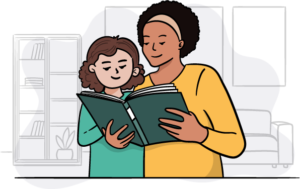
Creating an inclusive multilingual reading space
Create a welcoming, inclusive atmosphere that empowers a sense of belonging and identity:
- Involve learners in creating the reading area. The space could be a communal space in school that is visible and accessible for everyone. It could also be a designated reading space in a classroom where learners can go to read or look at books they enjoy.
- Make the space a comfortable and exciting place that will motivate and stimulate learners to want to read in. Provide, or ask parents if they can contribute cushions, beanbags, and chairs for learners to read comfortably on. Drapes and curtains are great for creating quiet corners and privacy to read.
- Make the space culturally appealing. For example, showcase cultural artefacts, puppets, ornaments, artwork, culturally inspired textiles and rugs and photographs that represent the different traditions and culture of all learners. Learners could be encouraged to create or bring in examples of these.
- Use the space to showcase the different languages spoken in the school, including proverbs and phrases, ‘hello’ posters and maps, and ‘language of the month’ displays to highlight and build a sense of local and global belonging and identities.
- Display photographs of learners reading with their families or friends.
- Think about a name for the space to make it appealing; for example, the language or multilingual lounge.
Sourcing culturally relevant books
1 in 3 children and young people aged 8-18 said that they would read more if they were given books that represent them (National Literacy Trust, 2026).
- Include a range of quality age appropriate dual language books in as many of the languages represented in the school. Dual language books have the text in both a home language and English. You may wish to do a regular audit of languages spoken in the school.
- Include a range of age-appropriate books that are representative of the cultural diversity in the school and authentically represent diverse lives.
- To help make books relevant and to encourage positive strong reading habits, find out what books
interest learners and understand what their hobbies and interests are by:
- Conducting a pupil survey.
- Asking parents what books their children like to read at home.
- Asking families to donate books in their languages as appropriate, or to bring books back from visits to their own countries.
- Creating short films of families reading together or grandparents reading to their grandchildren
- Include age-appropriate quality non-fiction books including bilingual dictionaries or subject/topic glossaries to nurture the area as a study space too.
- Display favourite book titles and reading recommendations.
Using the inclusive multilingual reading space effectively
Ensure the space is easy to use, interactive, and accessible to everyone.
- Organise books by different languages. Display the book covers outward on the lower shelves to make them more visible, appealing, and easy to browse.
- Label different areas of the reading space in the languages spoken by pupils. Provide multilingual signage and visuals to explain how to use the library. QR codes could be useful to do this.
- Provide audiobooks where possible in English and other languages so that stories can be heard aloud or listened to independently.
- Consider timetabling access to the reading space to ensure everyone has equal access to it.
- Ensure the reading space is used for meaningful learning opportunities to keep the area active and purposeful, such as group reading, running a book club, reading buddy or young interpreter programmes, and opportunities for teachers to model themselves as readers.
- Build confidence by positioning families as multilingual experts, and developing partnership opportunities for them to engage with and enjoy the space by inviting them in to:
- Use the space to read with their children e.g. after school.
- Run multilingual storytelling sessions.
- Ask parents if they want to be involved with managing or supporting the space.
- Attend workshops modelling how to read and share books with their children, including the importance of reading in their home language.
Conclusion
Multilingual reading spaces celebrate and value the rich linguistic and cultural identities in schools. Books open doors and windows to the world around us, helping learners to make connections with their heritage and culture, to ask questions, and to challenge assumptions. Therefore, when thoughtfully considered and planned, these spaces can help multilingual learners to feel seen, valued, and included, nurturing a sense of belonging and positive, active engagement with a love of stories and reading.
Resources and further reading
Useful websites for sourcing books in other languages:
References
- Clark, Picton & Cole: Children and young people’s reading in 2025, National Literacy Trust, June 2025: https://literacytrust.org.uk/research-services/research-reports/children-and-young-peoples-reading-in-2025/
- Conteh, J,. (2019) The EAL Teaching Book (3rd edition). Sage
- King, H. & Gonzalo P A: Creating a Multilingual library of picture books, NALDIC 2024: https://naldic.org.uk/creating-a-multilingual-library-of-picture-books/
- The National Literacy Trust (2026) See Myself in Books Festival. Available at: See Myself in Books Festival Boosts Literacy in Manchester Schools | National Literacy Trust posted on the topic | LinkedIn
- Teravainen-Goff, Clark & Little: Multilingual young people’s reading in 2021, National Literacy Trust, September 2021: https://nlt.hacdn.org/media/documents/Multilingual_reading_2021_Final.pdf
Thank you to our Licensed Practitioners Annie Bielby and Natasha Blows (Swansea Council) and Karolina Piera-Harris (Chiltern Teaching Hub) for sharing practical insights and examples from their settings.
Is your organisation interested in joining our team of licensed partners?
 The Bell Foundation is currently calling for new partners to join its network of licensed practitioners running EAL training in their regions. With the inclusion of EAL in the Ofsted inspection toolkit, our partners are seeing an increase in requests for training. We are looking to expand our network of licensed practitioners to meet that need.