
Questioning is a foundational and near-universal teaching and learning technique, but what does effective questioning look like and how can this be adapted for learners of English in international schools?
Most questions used in the classroom serve one of the following purposes:
- Finding out what learners already know or reminding them of something they have previously learned
- To assess the understanding of something that has been newly learned
- To make learners think more deeply, reflect, or produce new ideas
Having clarity on the purpose behind the questions you use when teaching will allow you to adapt questioning techniques more effectively to ensure EAL learners can fully participate.
Effective questioning can be broken down into four stages:
- Planning
- Asking
- Supporting (helping learners to respond effectively)
- Responding (building on learners’ responses) - this is explored in the second blog of this series
Here is a brief overview of what the first three stages involve and what to consider when teaching multilingual learners of English.
2. Planning
It is crucial to plan the questions and questioning strategies that will be used in the classroom. This should take into account the language proficiency of any EAL learners in the class.
- Design questions to directly support learning goals, including language development goals. Establish what learners already know and consider what questions will help move forward learners’ understanding of a topic. For learners of English this may also include questions that will help them deepen their understanding of vocabulary or extend their range of expression.
- Sequence questions from building basic knowledge to expanding thinking and language use. For example, learners at the early stage of learning English might benefit from more questions establishing basic concepts (who, what, where, when), allowing them to access the vocabulary they need to be able to make sense of the topic by activating prior linguistic and content knowledge. To expand language use, learners can be asked “How could you say that using more academic language?” or “What is the difference in meaning between X and Y?”
- Plan any resources students might need to help them understand the language used when listening and responding to questions. Examples include:
- visuals of key words;
- glossaries with simple definitions or translations;
- providing the questions in writing;
- providing translations of key questions for new to English learners when possible.
3. Asking
This may seem like the most straightforward stage of this process, but there are a lot of distinct areas to consider.
- Use comprehensible language. This means simplifying or ‘grading’ the language used to ensure our questions are comprehensible to as many learners as possible. For example, here is an example of a teacher question without language grading:
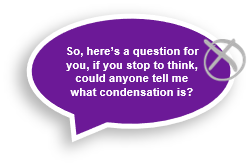
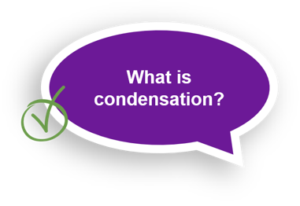
This question is too long and uses complex language structures such as a conditional structure and an embedded clause. A much more accessible way to ask this question is…
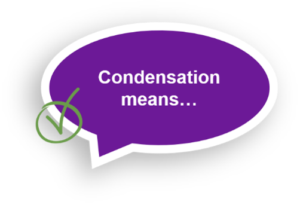
Another possibility is rephrasing it as a prompt rather than a question…
- Maximise participation.
This means phrasing questions in a way that allows as many learners as possible to participate and engages all pupils, not just EAL learners. Expecting learners to call out or put their hands up to answer is problematic, especially when we are checking for understanding, as they typically only provoke responses from learners who already know the answer. These techniques also favour more confident learners and are therefore likely to disadvantage EAL learners who may feel particularly self-conscious about speaking in front of the whole class.
Other asking techniques include nomination – but again, teachers must be careful not to select a learner to answer BEFORE the question is posed so that everyone else switches off. One solution here is name-end questioning where the question is posed first, there is a pause for all learners to consider a response, and then the teacher nominates a learner to respond. If the purpose of questioning is to assess understanding it is also worth considering the level of aptitude of the learners that are nominated. By nominating a learner who tends to be weaker in the subject area we potentially gather more useful information because, if they are able to answer correctly, there is a good chance the majority of other learners in the class also know the answer (for more detail see this excellent blog from Adam Boxer).
When assessing potential topic knowledge of your learners, it is important not to conflate English proficiency with content knowledge. A learner who is new to English may have excellent grasp of the content, albeit in a different language.
Calling out, hands-up, and nomination all have limited assessment value as participation is limited to a single student. A common solution to this challenge in many schools is using mini whiteboards, which allow ALL learners to respond to a question before showing their boards to the teacher at the same time, allowing the teacher to get an ‘at a glance’ sense of the level of understanding within the class and maximising participation and engagement.
3. Supporting
There are two key strategies to help EAL learners provide more effective responses to questioning:
Provide sufficient thinking time
Building in thinking time to allow learners to process their ideas and retrieve knowledge is crucial for all learners, but particularly important for EAL learners who have the extra cognitive burden of processing and producing ideas in a second language. Possible techniques include:
- Using mini whiteboards.
- Turn and talk (where a learner turns to their partner and discusses their response). This can be done in home languages when you have new to English learners who share a language.
- Roleplaying as an interviewer with a pretend microphone – giving the learners time to think while the teacher roves the classroom whilst clutching a whiteboard marker as a “microphone”.
- Getting learners to take notes in their home languages.
Scaffolding language
EAL learners may need support not only to understand questions, but also to respond effectively. Providing resources such as sentence frames, sentence starters, and substitution tables allow learners to respond in longer utterances than they might be able to produce on their own, as well as developing their awareness of English grammar and sentence structures.
Providing opportunities for EAL learners to discuss responses in their home languages first, before producing a response in English, can generate much richer and thoughtful answers. Here are examples from our teaching and learning resources:
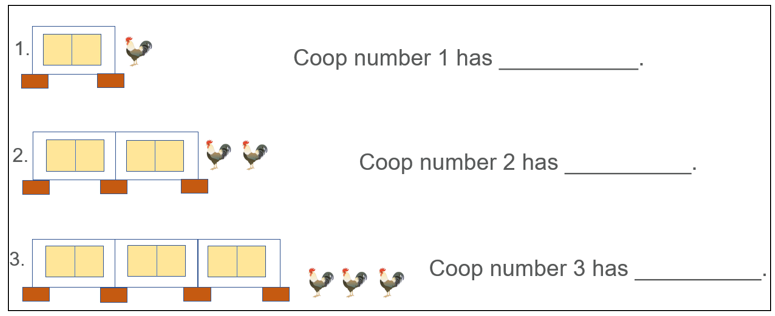
Image above: Sentence starters. Primary: Chicken Coop maths
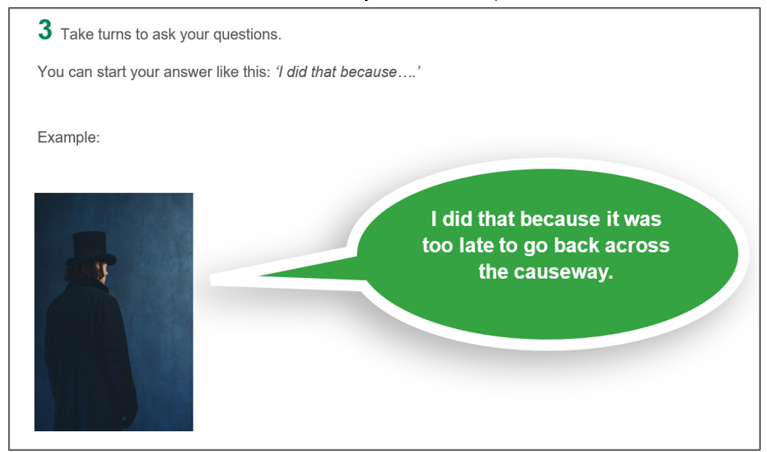
Image above: Sentence starters. Secondary English Literature: The Woman In Black
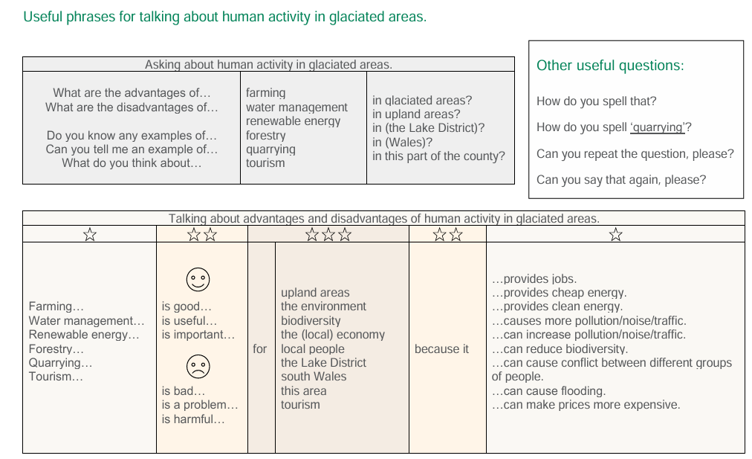
Image above: Substitution tables. Secondary geography: Glaciated landscapes
4. Responding
Building on learners’ responses allows the teacher to strengthen understanding, extend knowledge and – crucially for our multilingual pupils – develop language. Useful responding techniques include:
Stretch it/say it better
This involves inviting the learner to build on their initial response or rephrase it to make it more accurate. In most cases, the teacher’s priority should be the content of the response rather than the fluency, pronunciation, or grammatical accuracy – as long as the meaning is clear. However, in cases where the content is correct, but the teacher believes the learner could do better in terms of their language, then a language-focused response might be appropriate such as “Could you say that again and this time use the past tense?” or “Can you say that again with a better word than ‘nice’?”.
Recast
This involves repeating the response back to the learner but using upgraded language or correcting a language mistake. It can be useful to get the learner to repeat the recasted version back to you, to make them aware of which element of their response could be improved.
Bounce
Offering out the question to other learners to expand on or improve on the answer. Here it is important to know the different language proficiencies present in the classroom, as bouncing the question to a learner who may struggle to produce the language needed to answer will not be effective. This may also be an opportunity to encourage translanguaging to promote fluency – especially if you are in a context where all the learners share a home language.
Loop
This is an extra stage that can be added after ‘bouncing’ a question around other learners by returning to the original student who answered incorrectly or incompletely and asking them to give a complete answer. This can be especially impactful for EAL learners as it gives them the chance to repeat key vocabulary.
Learn about the fourth and final phase to the questioning process, checking learners’ understanding, in our second blog in the series.