

How to adapt teaching for learners who use EAL (online course)
- Date
- 3 November 2026
- Time
- 9:00am
- Price
- £49 - £73
- Type
- Online course, Run by The Bell Foundation
- Location
- Online
Planning for language involves identifying the language learners will need to engage successfully in a challenging classroom curriculum as part of regular lesson planning. It also involves planning how learners will encounter and use this language meaningfully in the lesson, along with support that is responsive to individual learner needs and levels of English language proficiency.
Planning for language is central to making informed decisions about what language to focus on during the lesson and what scaffolds to use.
Identifying the linguistic resources a learner will need begins by considering what learners are being asked to think about and communicate. Different tasks, such as describing, explaining, comparing, etc., require different kinds of language (Halliday, 1993). For example, consider the Roman invasion of Britain below. Although the curriculum topic remains the same, the purpose of the task determines the language learners need to express their understanding.
| Same topic | Different task | Different language demands
|
| The Roman invasion of Britain. | Describe Roman soldiers. | Descriptive language, precise noun groups, adjectives.
|
| The Roman invasion of Britain. | Explain why the Romans invaded. | Cause-and-effect language (because, as a result, therefore).
|
| The Roman invasion of Britain. | Compare Roman and Celtic lifestyles. | Comparative language (similarly, in contrast, both have).
|
| The Roman invasion of Britain. | Evaluate whether the invasion benefitted Britain. | Evaluative language (the evidence suggests, this indicates, it says).
|
Identifying key vocabulary is an important part of planning for language. However, effective language planning extends beyond vocabulary alone. It also involves identifying the purpose of the text, considering how texts – whether spoken, written, or multimodal – are organised (text level), how ideas are connected within and across sentences (sentence level), and how key words and phrases are chosen to convey precise meaning (word level) (Derewianka, 2016).
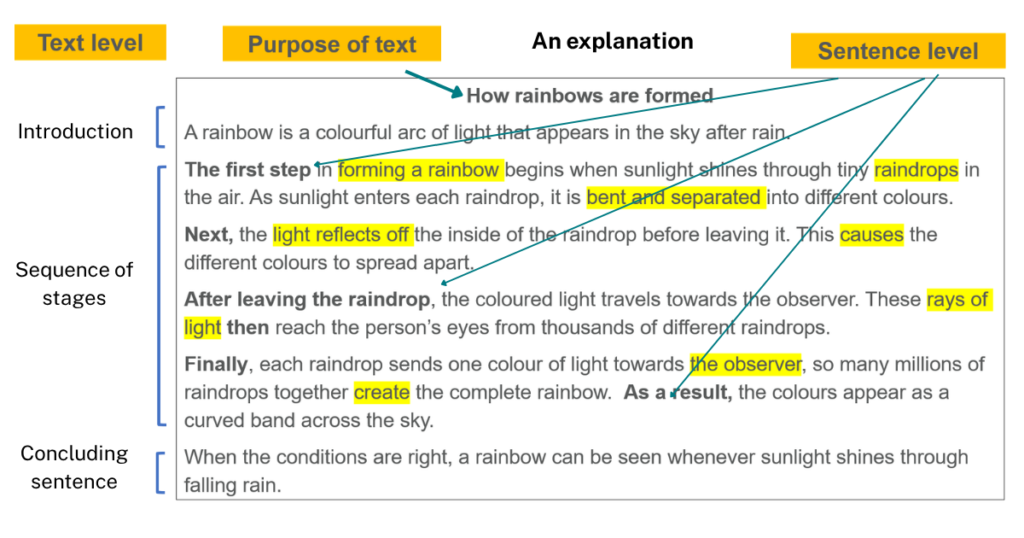
For example, when planning for learners to read the science text below, it would help to identify its purpose (an explanation of how rainbows are formed), how it is organised (as a sequence of stages), and how language is used to connect the sequence of those stages at the sentence level. Planning for how you will explicitly highlight these language features during reading can support learners' comprehension while also helping them to use similar patterns when they come to discuss or write explanations on their own.
The framework below provides some examples of language features at the text, sentence, and word-level language typically associated with common curriculum genres, or purposes, across different subject areas.
| Purpose | Text level | Sentence level | Word level
|
|

Science |
Explain
e.g. explain how water changes state |
|
|
|

History |
Recount / Evaluate
e.g. recount the events and discuss their impact
|
|
|
|
|
Maths
|
Justify / Reason
e.g. tell me how you solved the problem |
|
|
|
|
English
|
Persuade / Argue
e.g. write a persuasive argument
|
|
|
|
Language develops progressively through repeated opportunities to use and extend it in meaningful curriculum contexts (Cummins, 2021). For this reason, planning for language is not about teaching every language feature in every lesson, that would be impossible. Rather, it involves selecting those language features that best support learners' participation in the lesson. Depending upon the activity, this could involve:
A useful way to plan for language development is to work through five key questions in Pauline Gibbons’ planning framework alongside regular unit or lesson planning (Gibbons, 2015).
| Planning question | Planning guidance
|
| 1. What are pupils learning?
|
Start with the curriculum content (e.g. photosynthesis) recognising that English is best developed through meaningful engagement with the curriculum.
|
| 2. What are leaners being asked to do? | Identify the purpose of the learning task (e.g. recount a story, justify an opinion), as different tasks require different kinds of language.
|
| 3. What language will learners need? What will you prioritise? | Identify the language that will have the greatest impact on pupils' success and plan to teach or highlight this explicitly (e.g. using the past tense to write a recount).
|
| 4. How will the language be supported? | Choose scaffolds that match the language demands. For example, rather than simply asking learners to 'talk to your partner', provide sentence frames that support the purpose and language needed for the discussion.
|
| 5. How will learners use the language?
|
Plan repeated opportunities for learners to use the language purposefully through speaking, writing, and reading so they can apply it in meaningful contexts.
|
Another planning framework adapts the Teaching and Learning Cycle (Derewianka, 2016) by highlighting key planning considerations at each stage.
| Teaching stage | Planning questions
|
| 1. Building the field
|
What background knowledge, experiences and essential vocabulary will learners need before engaging with the curriculum? How will you provide this?
|
| 2. Modelling and deconstructing the text
|
Which text, sentence and word-level language features should be made explicit, modelled, deconstructed? How will you do this? Are there model texts that will best illustrate these features?
|
| 3. Joint construction of the text | How will you jointly construct spoken or written texts with learners before gradually releasing support? Consider how modelling, questioning, and guided discussion will help learners make language choices.
|
| 4. Independent construction of the text
|
How will learners use the target language independently to demonstrate their understanding? |
A typical lesson may focus on one or two language features that will help learners engage successfully with the task. Those features might include:
The specific focus will depend on the lesson purpose, the learners’ needs and their English proficiency. To see how this can be put into practice, explore the activities on the Great Ideas page, Integrating Content and Language, or visit other support strategies from our Great Ideas collection.
Make planning for language manageable:
Planning for language development is important because it makes visible the language that learners need to participate successfully in classroom learning. Gibbons (2015) argues that academic language is rarely acquired simply through exposure to curriculum content alone. Instead, by identifying the language demands of a lesson alongside learners' English language proficiency during planning, teachers can create clear links between the language learners need and the support they receive as they engage with challenging tasks (Hammond and Gibbons, 2005).
Without this planning, language support is more likely to be reactive than intentional, relying on in-the-moment strategies such as simplifying tasks or reducing explanations. While these strategies may be useful in the moment, they can unintentionally limit opportunities for learners to engage with challenging curriculum and develop school-based language (Walqui, 2006).
Although particularly important for multilingual learners acquiring English, making the language of the curriculum explicit benefits all learners by supporting access to subject knowledge and enabling everyone to engage with the distinctive ways of meaning making in each unique subject area.
References
Cummins, J. (2021). Rethinking the education of multilingual learners: A critical analysis of theoretical concepts. Multilingual Matters.
Derewianka, B. and Jones, P. (2016). Teaching Language in Context. 2nd ed. Melbourne: Oxford University Press.
Gibbons, P. (2015). Scaffolding Language, Scaffolding Learning: Teaching English Language Learners in the Mainstream Classroom (2nd ed.). Portsmouth, NH: Heinemann.
Halliday, M.A.K. (1993) Towards a language-based theory of learning, Linguistics and Education, 5(2), pp. 93–116.
Hammond, J., & Gibbons, P. (2005). Putting scaffolding to work: The contribution of scaffolding in articulating ESL education. Prospect, 20(1), 6–30.
Walqui, A. (2006). Scaffolding instruction for English language learners: A conceptual framework. International Journal of Bilingual Education and Bilingualism, 9(2), 159–180.