Regional training
Introduction to EAL Assessment – Primary (Online Regional Training)
- Date
- 16 October 2026
- Time
- 1:30pm
- Price
- £49
- Type
- Online course, Regional training
- Location
- Online
Explore our nine new calls for change as the government reviews ESOL provision
Developing academic vocabulary refers to classroom strategies aiming to enrich the range of vocabulary that learners using EAL have at their disposal. It means ensuring that they go beyond basic and communicative/social vocabulary associated with Bands A and B or Tier 1 vocabulary of English language acquisition towards more formalised, specialised and more abstract vocabulary associated with Bands C to E (Tiers 2 and 3 vocabulary).
The vocabulary tiers classify words by how frequent there are, how complex they are and context in which they are used. Tier 1 words are basic words, used in everyday communication. Tier 2 words a high frequency and multiple meaning words: sophisticated vocabulary often seen in academic settings and texts, transferrable across academic domains, e.g., analyse, maintain, significant, tendency. Finally, Tier 3 is domain-specific vocabulary: technical and specialised jargon, e.g., osmosis, photosynthesis, baroque, teleology.
Often in the classroom, learners at lower bands of English language proficiency have new academic Tier 2 and 3 English vocabulary simplified for them to enable understanding and access to the curriculum, but it is less often that the same learners are supported to master the original academic vocabulary that was simplified for them. All the examples of activities presented in the next section are based on the idea of unpacking (simplifying) the academic language first, and then repacking it: taking the learners back to learn the academic vocabulary they need for school.
Note that this article is about academic vocabulary only, not academic language more broadly; the latter would encompass grammar and other language aspects beyond that of vocabulary, but here our sole focus is vocabulary.
First, examine the image below, based on Karl Maton’s theory and research which all the activities below are underpinned by.
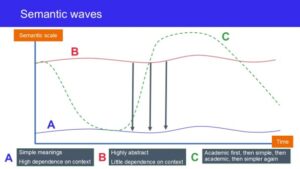
The three examples of activities below follow these two stages.
In a lesson about Rosa Parks and Emily Davison’s lives, all children in the classroom receive a written biography about the two women.
This example is based on The Bell Foundation’s resource The boiling point of water and the vocabulary in the flashcards there.
Matching activity
Gap fill
Complete the gaps and write a number in the column on the left to sequence the instructions.
| No | Picture | What happens |
 [1] [1] |
We ___________ (put water in) 100ml water into a beaker. | |
 [2] [2]  [3] [3] |
We ___________ (put) the beaker on a tripod and gauze. | |
 [4] [4] |
We wanted to ___________ (learn) out what the boiling point of water is. | |
 [5] [5] |
We ___________ (started fire) the Bunsen burner using a wooden spill. | |
 [6] [6] |
We turned on the gas. | |
 |
We ___________ (watched) the water until it boiled. | |
 |
We ___________ (made hot) the water using the blue flame on the Bunsen burner. | |
 |
We ___________ (calculated) the temperature with a thermometer. |
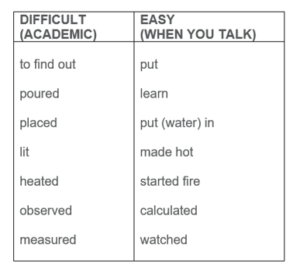
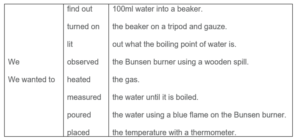
Put these academic words in the gaps above, changing easy/spoken language to academic/serious language.
| find out | poured | placed | lit |
| heated | observed | measured |
Image credits:
[1] New Africa/Shutterstock.com, [2] Mehmet Cetin/Shutterstock.com, [3] Bangyos24/Shutterstock.com [4] Brothers klia/Shutterstock.com, [5] Air Images/Shutterstock.com, [6] Rabbitmindphoto /Shutterstock.com, [7] Etienne du Preez/Shutterstock.com, [8] ggw/Shutterstock.com, [9] Olga_Kostrova/Shutterstock.com
Substitution table
The class are studying William Shakespeare’s Macbeth, and the lesson focuses on the profile of Lady Macbeth. The worksheet provided to all learners includes words such as pivotal, plot, plagued, commit (suicide) and paranoia.
Stage 1: The teacher has provided a Pelmanism game to pairs of learners using EAL (a memory card game), where they have to find pairs of cards: synonyms of academic and non-academic words, e.g. pivotal = very important, and plagued = troubled. Learners then match these words to sentences provided with gaps in them, e.g. Lady Macbeth was plagued/troubled by guilt.
Stage 2: Now the learners complete a blank template of Lady Macbeth’s profile by using only academic vocabulary they just learned through the game.
When setting up these activities, it will be important to bear in mind the following:
Top tip: Repetition is key to learning any new vocabulary and this context is no different. Consider activities where learners are encouraged to repeat and/or encounter the same words, e.g. finding card pairs (flashcards), gap fills where learners need to use the same academic words/phrases in different sentences and labelling pictures with more formal vocabulary they just learned.
First of all, many years of research at The University of Oxford have demonstrated that multilingual learners’ academic proficiency in English is crucial to their achievement and thriving in the English school system (Lindorff, Strand and Ma, 2025).
The strategies described above have been inspired by the concept of semantic waves within the wider legitimation code theory developed by Karl Maton (2013). Semantic waves is a framework describing how effective teaching moves between abstract and technical ideas (academic vocabulary: Tiers 2 and 3) and every-day, concrete examples (Tier 1).
There are two dimensions:
| Dimension | Explanations and examples |
| Semantic gravity (SG) | SG- (low gravity): abstract concepts and theories Examples: capitalism, gravity
SG+ (strong gravity): specific, concrete, real-life examples |
| Semantic density (SD) | SD+ (strong density): technical language or jargon Examples: photosynthesis, algorithm SD- (weak density): everyday language |
Therefore, academic language (the upper part of semantic waves) is more abstract (SG-) and dense (SD+) while less academic language (the lower part of the wave) is more linked to context (SG+) and its meaning less dense (SD-). It is a difference between decontextualised and technical language vs contextualised, everyday vocabulary. This is reminiscent of the classic Cummins Quadrant (1984) where he distinguished between language that is context-embedded and context-reduced as used in the classroom.
Following a semantic wave structure in a lesson or a unit of work enables access to expert knowledge to novice learners. Semantic waves provide different contexts for concepts with numerous concrete examples on offer and connect technical, abstract terminology with simpler meanings. Finally, it helps learners to unpack concepts and then repack them into more sophisticated concepts.
Cummins, J. (1984). Bilingualism and special education: Issues in assessment and pedagogy. Clevedon, England: Multilingual Matters Ltd.
Lindorff, A, Strand S. and Ma, Y. (2025). English as an Additional Language (EAL) and educational achievement in England in 2023: an analysis of the National Pupil Database. Available at: https://www.bell-foundation.org.uk/app/uploads/2025/11/EAL-attainment-2025-Oxford-report.pdf [Accessed 10 Jun 2026].